Proudly based in Bexley, Kent
Mon - Fri: 9am - 5pm
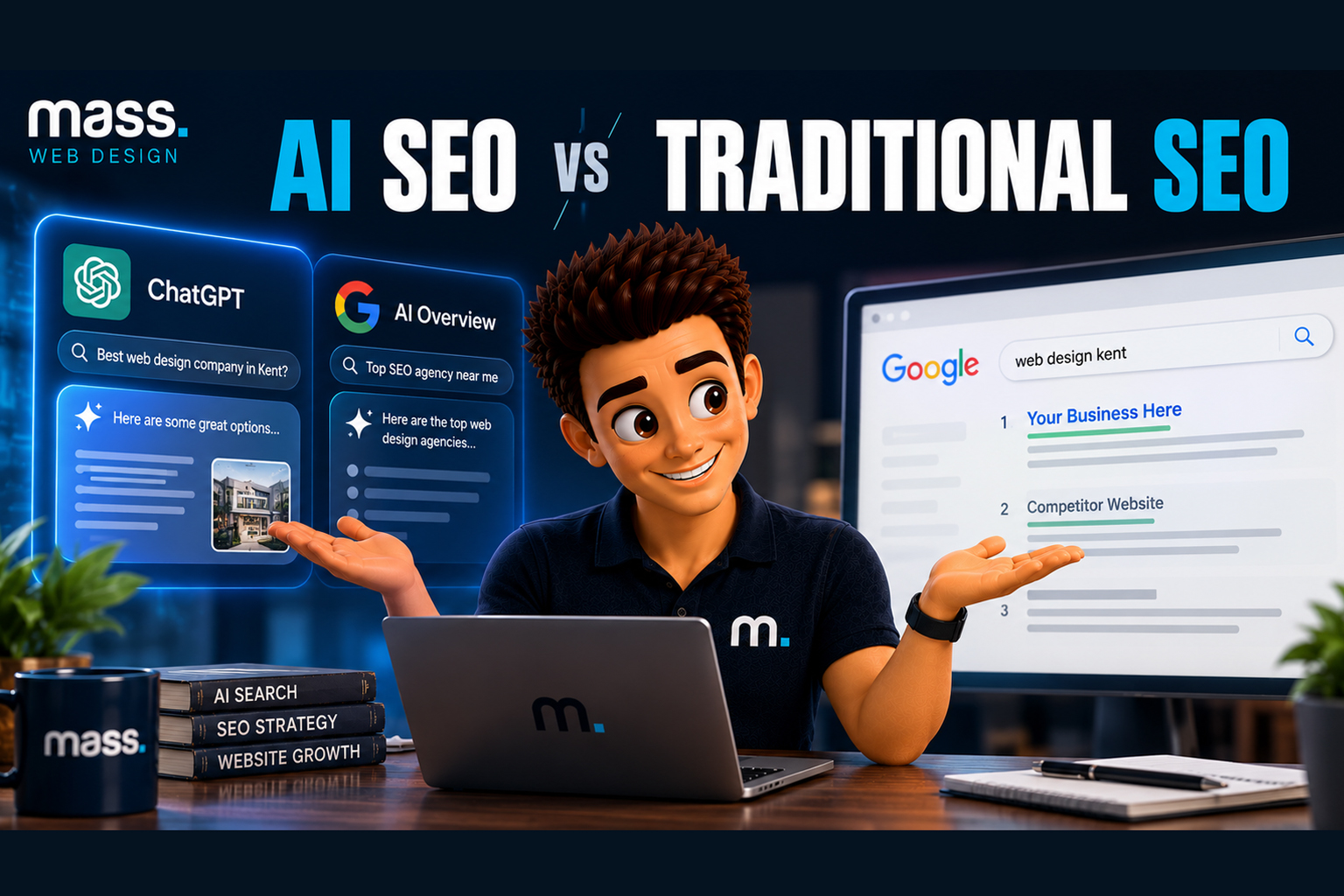
For years, getting found online largely meant one thing:
Ranking on Google.
Businesses invested in Search Engine Optimisation (SEO) to appear when potential customers searched for their products or services.
That’s still incredibly important.
But the way people search is changing.
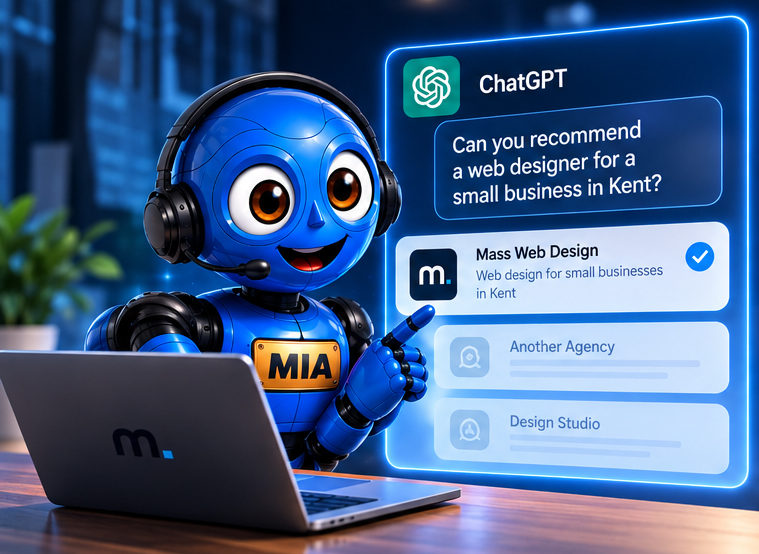
Customers can now ask tools such as ChatGPT, Google Gemini, Google AI-powered search experiences and other AI assistants questions like:
Instead of simply displaying a page of links, AI can provide a direct answer, summarise information and sometimes recommend particular businesses or sources.
This has led to a new question for business owners:
Do I still need traditional SEO, or should I now be optimising for AI search?
The answer isn’t about choosing one or the other.
Let’s look at how they differ, where they overlap and what businesses should be doing in 2026.
SEO stands for Search Engine Optimisation.
It’s the process of improving your website and online presence so search engines can better understand your business and potentially show your pages for relevant searches.
For example, someone might search:
Traditional SEO aims to make your website relevant and useful for searches like these.
SEO can include:
The objective isn’t simply to attract as many visitors as possible.
Good SEO should attract the right visitors: people genuinely interested in what your business offers.
You’ll increasingly hear terms such as:
Although the terminology is still developing, they broadly describe improving your online content so it can be understood and potentially surfaced by AI-powered search and answer systems.
Instead of thinking only:
“How do we rank number one for this keyword?”
Businesses also need to consider:
“How clearly does the internet understand who we are, what we do and why we’re relevant to this question?”
That’s an important distinction.
Imagine you need a web designer.
A traditional Google search might be:
Web designer Kent
You’re then presented with search results, map listings, advertisements and other features.
With conversational AI, your query could become much more specific:
“I’m a small construction company in Kent. Can you recommend what I should look for in a web designer who understands local SEO and can provide ongoing website maintenance?”
That’s much closer to a conversation than a traditional keyword search.
People can add context, ask follow-up questions and refine what they want.
This means businesses need content that answers real customer questions, not simply pages designed around individual keywords.
No.
SEO is evolving, not disappearing.
Search engines still need to discover, understand and evaluate websites.
And many of the things that make a website strong for traditional search also make its content easier for other systems and, importantly, customers to understand.
These include:
Rather than abandoning SEO for AI optimisation, businesses should strengthen the fundamentals.
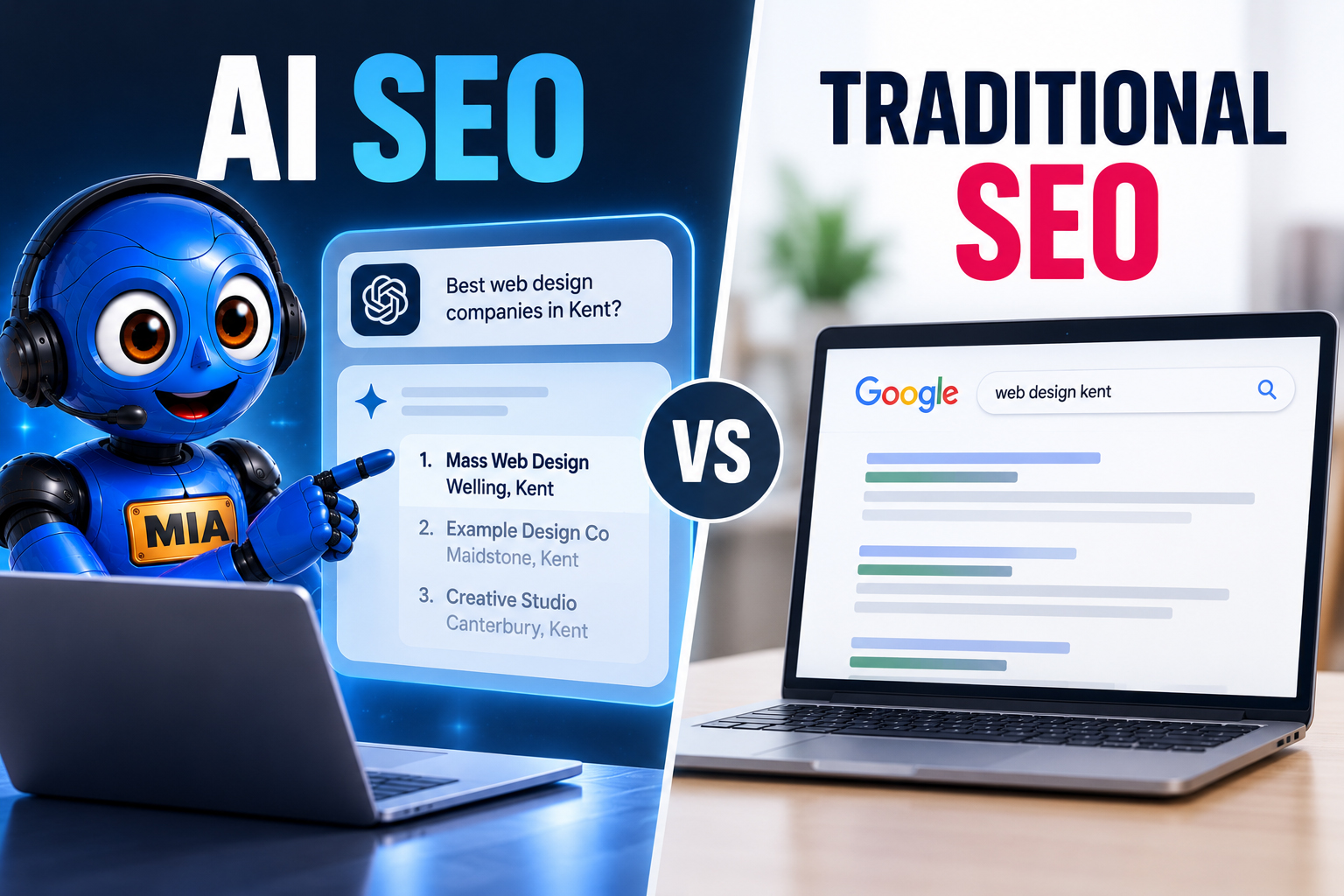
Here’s a simple way to understand the difference.
Traditional SEO asks:
“How can this page appear for a relevant search?”
AI-focused optimisation also asks:
“How can our business become a clear, trustworthy and useful source when someone asks a question?”
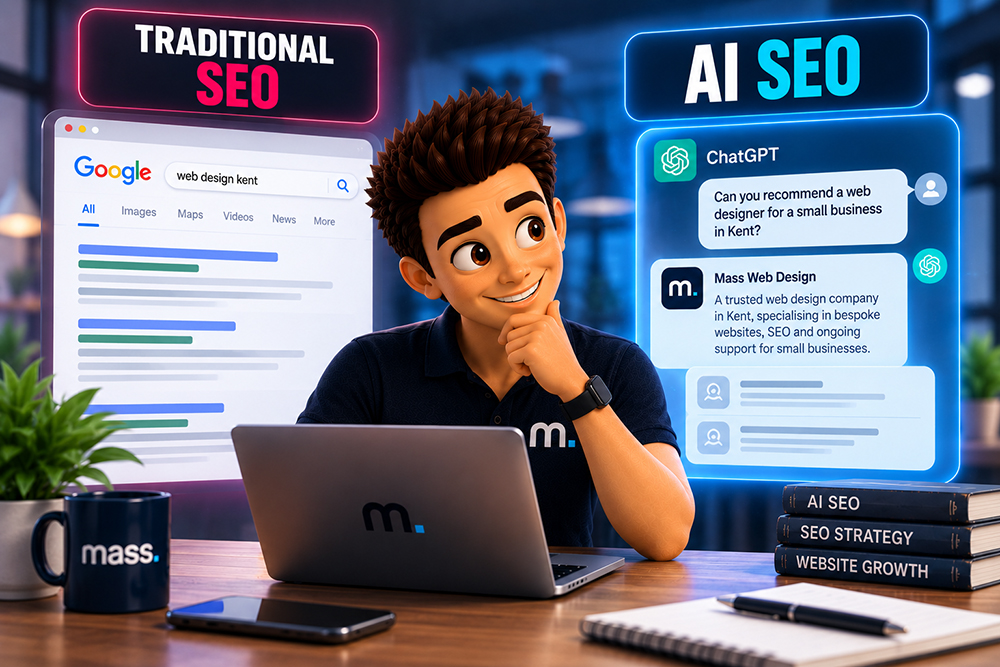
Traditional search may lead someone to your website.
AI may summarise information before that person ever visits it.
That makes brand authority, clarity and trust increasingly important.
Traditional SEO has always involved understanding what people type into search engines.
For example:
website design cost UK
But conversational search can be much more detailed:
“How much should a small business expect to pay for a professionally designed website in the UK?”
Businesses should therefore create content that naturally answers detailed questions.
This is one reason FAQs and in-depth guides can be so useful.
One mistake we regularly see is businesses trying to explain everything they do on one page.
Imagine a building company offering:
Giving important services their own useful pages makes it easier for potential customers and search engines to understand what the company actually offers.
Instead of one vague Services page, you can build genuine authority around individual areas of expertise.
One of the best content strategies for both traditional and AI search is surprisingly simple:
Write down the questions your customers ask you.
Those questions could become your content strategy.
For a web design company, they might include:
Every useful answer gives your website another opportunity to demonstrate expertise.
Anyone can write:
“We’re experts.”
It’s much more powerful to prove it.
Show:
If you redesigned an outdated website, explain the challenge and what you changed.
If you helped a business improve its online presence, create a case study.
Real experience is difficult to replicate with generic AI-generated content.
Your website doesn’t exist in isolation.
Information about your business may appear across:
Consistency matters.
Your business name, services, website and contact information should be accurate wherever appropriate.
Building a genuine brand is increasingly important.
Reviews are valuable for far more than simply displaying five stars.
They help potential customers understand:
For local businesses in particular, reviews can play an important role in building credibility.
Don’t wait until you desperately need reviews.
Make requesting genuine feedback part of your normal customer process.
If your business serves a particular geographic area, local visibility remains extremely important.
Someone looking for an electrician in Dartford doesn’t usually want one 200 miles away.
Make your service areas clear.
This can involve:
Avoid creating hundreds of identical pages with only the town name changed.
A good local landing page should provide something genuinely useful.
Don’t make people fight through a wall of text.
Use:
Good structure helps visitors scan a page quickly and understand whether it answers their question.
Clarity benefits humans first, but it also makes content easier for machines to interpret.
With all the excitement around AI, it’s easy to forget the basics.
Your website still needs to work properly.
That means checking:
There isn’t much point publishing brilliant content if search engines struggle to access your website or customers leave because pages take forever to load.
Structured data, often referred to as schema markup, provides search engines with additional machine-readable information about a page.
Depending on the website and content, structured data can help describe things such as:
It isn’t a magic ranking switch and doesn’t guarantee that your business will appear in an AI-generated answer.
Think of it as another way of making your website’s information clearer.
AI can be an incredibly useful tool.
It can help with:
But automatically generating hundreds of low-value pages isn’t a sustainable SEO strategy.
Your content still needs to provide something useful.
Add:
AI should help businesses create better content, not more rubbish.
This may be the most important point in this article.
Your website ultimately exists for people.
If you spend all your time trying to manipulate algorithms, you can easily end up making your website worse.
Instead ask:
If the answer is yes, you’re already heading in the right direction.
In 2026, we’d recommend thinking about them as part of the same wider search strategy.
You still want to appear when someone searches Google.
But you also want your business and content to be understandable when people use newer AI-powered ways of discovering information.
The strongest approach combines:
SEO + Content + Local Search + Brand Authority + Technical Performance + AI Search Readiness
Rather than chasing every new acronym, build a strong online presence that can adapt as search evolves.
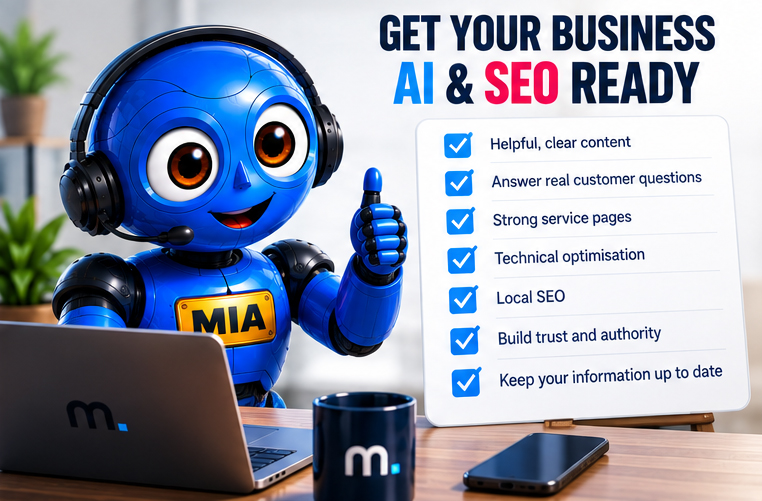
Ask yourself:
If you’ve answered no several times, that’s where I’d focus before worrying about advanced AI optimisation techniques.
What is AI SEO?
AI SEO is a broad term used to describe optimising online content and brand information for a search environment increasingly influenced by artificial intelligence.
It can include creating clear, useful content, demonstrating expertise, improving website structure and strengthening the information available about a business online.
What is GEO?
GEO usually stands for Generative Engine Optimisation.
It’s commonly used to describe techniques intended to improve a brand or website’s visibility within generative AI experiences.
It’s a relatively new area, so terminology and best practices continue to evolve.
What is AEO?
AEO stands for Answer Engine Optimisation.
The focus is on creating content that clearly answers the questions people are asking rather than only targeting traditional keywords.
Can I pay to appear in ChatGPT recommendations?
Organic AI recommendations shouldn’t be treated like traditional advertising positions that a business can simply purchase.
The better strategy is to create a strong, authoritative online presence and useful information about your business.
Can you guarantee my business will appear in ChatGPT?
No reputable SEO provider should guarantee that an independent AI system will recommend a particular business.
AI-generated responses can change and may draw upon different sources depending on the query.
Instead, businesses should focus on improving the signals they can control.
Should small businesses still invest in Google SEO?
Yes.
Google remains an important source of visibility and high-intent website traffic for businesses.
The rise of AI search means businesses should broaden their strategy, not abandon traditional SEO.
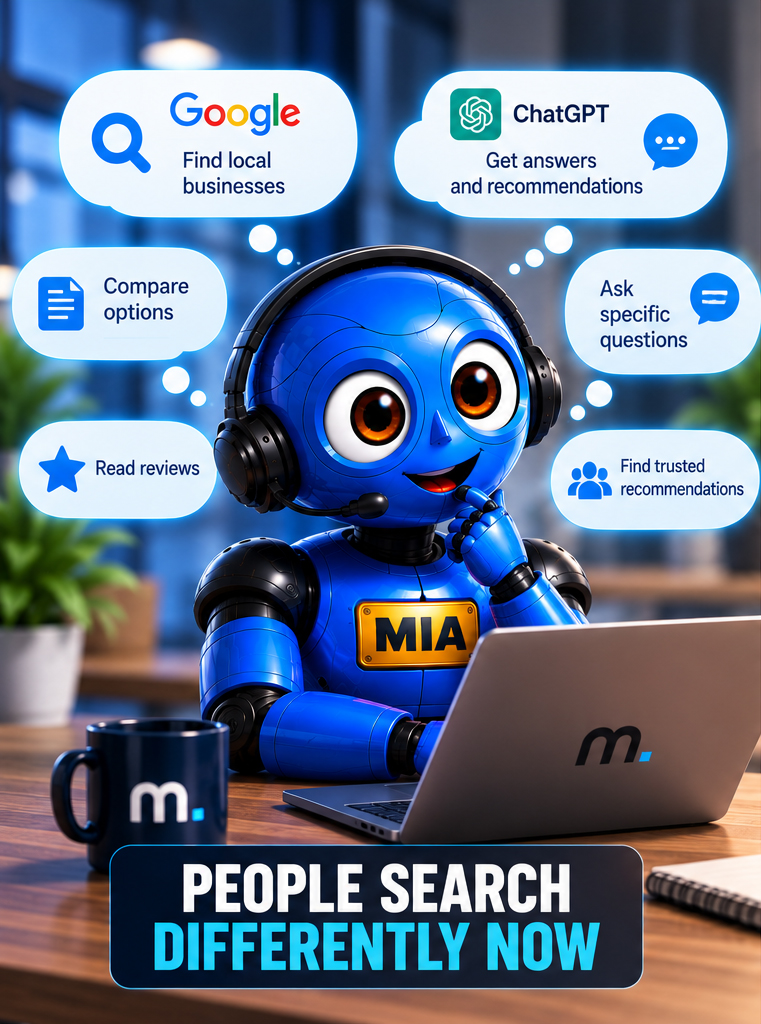
People aren’t going to stop searching.
But how they search is changing.
Some customers will use Google.
Some will use Google Maps.
Some will ask ChatGPT.
Others will use Gemini, AI-powered search experiences, social media or platforms that haven’t become mainstream yet.
Businesses don’t need to predict exactly which platform will dominate.
They need a digital presence strong enough to be discovered wherever their customers choose to search.
That means creating a fast, professional website, publishing genuinely useful content, demonstrating real expertise and continuously strengthening your online authority.
At Mass Web Design, we help businesses build websites designed for more than simply looking good.
We focus on websites that are fast, professional, search-friendly and built to generate enquiries.
Whether you need a new website, an SEO strategy, local landing pages, regular content or help improving your visibility online, we can help.
Get in touch with Mass Web Design for a free website and SEO review.
We’ll identify opportunities to improve your website’s visibility across traditional search and the rapidly evolving world of AI-powered search.
We would love to work with you on your next project or breathe new life into an existing one. Speak to our experts today!
Contact usTell us about your project and we’ll come back to you with the next steps and a free quote.
Tell us a little about what you need.